.png)


Vulnerability Scanning Products
VANS Vulnerability Reporting Assistant ToolDVM Vulnerability Scanner (Full Chinese Interface)Downloads
Product CatalogVulnerability Scanning Products
VANS Vulnerability Reporting Assistant ToolDVM Vulnerability Scanner (Full Chinese Interface)Downloads
Product CatalogSeptember 23, 2026
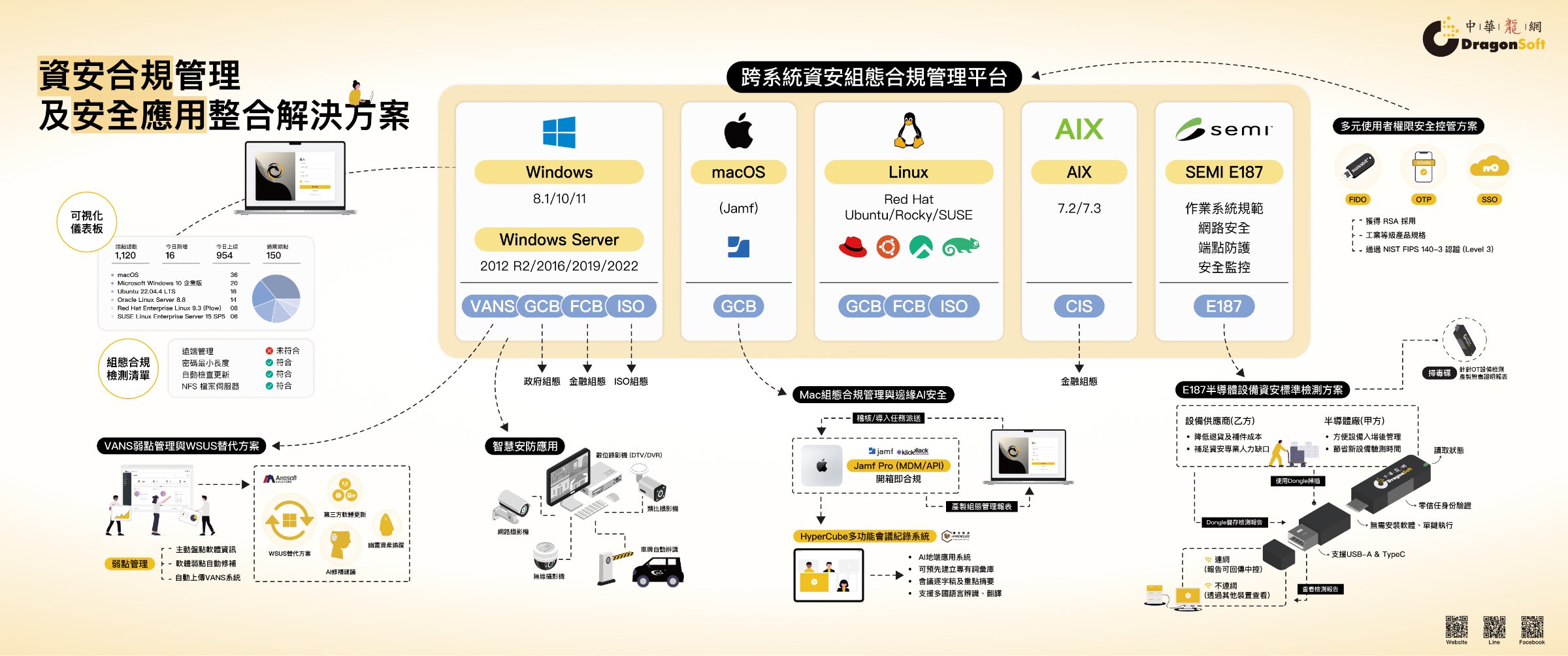
Cross-platform management and multi-scenario integrated application solution
As AI-driven digitalization accelerates, government agencies and enterprises rely on ever more computers, servers, and endpoint devices. Management is no longer a matter of a single system or a single tool, but an overall challenge that spans platforms, roles, and environments. Whether for internal office work, remote work, or public-facing service platforms, nearly everything depends on a large number of IT devices and systems running reliably.
If this work still relies on manually inventorying each machine, manually checking settings, and manually pushing vulnerability patches, efficiency drops and labor costs rise, while security risks and management gaps become more likely. How to effectively carry out configuration management, endpoint monitoring, vulnerability patching, and security protection is a challenge governments and enterprises are facing today. DragonSoft's integrated solution builds on cross-platform security configuration compliance management and further integrates vulnerability patching, semiconductor equipment inspection, multi-factor identity authentication, and on-premises AI applications into a more complete security management solution.
From mainstream Windows and Windows Server, to Linux distributions widely used in finance (Red Hat, Rocky, SUSE) and AIX, to macOS, which the government has recently brought under management, each operating system has its own configuration logic, deployment methods, and security baselines. Managing them separately increases operational complexity and fragments compliance checks, vulnerability patching, and audit tracking.
Take the Government Configuration Baseline (GCB) as an example: its requirements cover operating systems, browsers, network devices, and applications. After implementation, organizations must confirm that devices still work properly and decide whether exceptions are needed in practice. Configuration management is not a one-time setup; continuous monitoring and consistent enforcement are what day-to-day security compliance should focus on.
macOS is no longer a rare exception in the enterprise. How can it be deployed quickly while reducing security vulnerabilities, without disrupting users? With Jamf Pro's compliant-out-of-the-box automated deployment, users can power on a new Mac and have the system installed and GCB configuration applied automatically. Combined with DragonSoft's platform monitoring, audit implementation, task distribution, and reporting capabilities, configuration management becomes visible, traceable, and easy to enforce, keeping risk under control at all times.
WSUS (Windows Server Update Services) is Microsoft's centralized update management tool for Windows, but how should updates be managed once it reaches end of support? The vulnerability patching add-on module integrated with Arrosoft supports patch updates for Windows, Windows Server, Linux, macOS, and a wide range of third-party software, and provides intelligent patch recommendations compiled by AI Copilot, including a patch overview, potential risks, and low/medium/high stability ratings.
If the environment still contains unmanaged devices or devices without an agent installed, the system can discover ghost assets through local network scanning and AD scanning, helping organizations find potential sources of risk and avoid blind spots caused by overlooked devices. The system can complete asset inventory, show information on every device and its applications, and display vulnerabilities found across all devices, filterable by affected product, severity, or patch availability, so administrators can see the distribution of risk more quickly.
The semiconductor industry's importance to the world is well known. The scope of configuration management extends beyond internal endpoints and servers: equipment suppliers and equipment entering the fab must also meet corresponding security and compliance requirements. Following past ransomware incidents, the SEMI E187 standard was introduced, and the industry has begun to focus on equipment-level security inspection.
SEMI E187 compliance requirements cover the operating system, network security, endpoint protection, and security monitoring. DragonSoft's semiconductor security compliance inspection tool helps equipment be inspected and accepted for security before it enters the fab, making post-entry management easier for semiconductor manufacturers and shortening new-equipment inspection and acceptance. It also helps equipment suppliers reduce the high cost of returns and resubmissions and fill security staffing gaps. The tool supports Chinese, English, and Japanese, uses a zero trust dongle, and includes a built-in encrypted partition to meet the highest security standards.
As IT environments grow more complex, beyond endpoint protection and vulnerability patching, who the users are, how they sign in, and what they can access matter just as much. When government agencies and enterprises must handle internal systems, cloud services, remote work, and external access at the same time, the lack of consistent authentication and access control can lead to loose account management, inconsistent verification standards, and difficult audit tracking.
Within the integrated solution's architecture, the DragonSoft platform supports SSO, OTP, FIDO, and other authentication methods, allowing organizations to build more consistent and flexible authentication for different systems and risk scenarios. We partner with German vendor Swissbit to provide an industrial-grade FIDO token that supports zero trust and MFA, is NIST FIPS 140-3 certified, and has been adopted by RSA, helping improve the reliability and controllability of the overall authentication process.
Further reading: FIDO Case Study
For government agencies and enterprises, meeting records often involve project plans, decisions, and sensitive internal information. Relying on manual transcription, hand-written summaries, and follow-up tracking is time-consuming and prone to information gaps and extra workload. The DragonSoft AI Speech Recognition System uses on-premises deployment and can run on edge computing devices such as an Apple Mac mini or an industrial PC, supporting both file-based and real-time recognition.
The system recognizes more than a hundred languages as well as mixed Mandarin, Taiwanese, and English speech, handling multilingual meetings. It also offers similar-sound search and replace and preloaded glossaries of proper nouns to improve recognition accuracy. With multiple output formats and document templates, it can produce verbatim transcripts, summaries, readable drafts, and subtitles for meetings, speeches, courses, and more. There is no need to rely on the public cloud: with this on-premises device, recognition, translation, and speech content processing are all completed within the internal environment, making it especially suitable for organizations with high information security requirements.
For government agencies and enterprises, security configuration compliance management should not stop at meeting government regulations; it should establish a management model that runs long-term, monitors continuously, and balances efficiency with security. Security management is like the steel reinforcement in a building: unseen, yet it supports the safety of the whole structure. Only when a platform can handle endpoint management, compliance monitoring, identity verification, and extended application scenarios at the same time can it truly help organizations reduce risk, improve efficiency, and strengthen security in complex IT environments.